
Benign paroxysmal positional vertigo, or BPPV, is a common cause of brief episodes of spinning dizziness.
It happens when tiny calcium crystals in the inner ear move into a part of the balance system where they do not belong.
Typical symptoms
- Brief spinning or vertigo triggered by changing head position
- Symptoms when rolling over in bed
- Dizziness when lying down or sitting up
- Symptoms when looking up or bending down
- Episodes usually last less than a minute
- Nausea may occur
You may feel slightly unsteady between episodes, but BPPV usually does not cause continuous severe vertigo.
How is it diagnosed?
BPPV is usually diagnosed by your symptoms and a positional examination in clinic. During the examination, your head is moved into specific positions while your eye movements are observed.
Treatment
BPPV is usually treated with a repositioning maneuver, such as the Epley maneuver.
The maneuver moves the displaced crystals back to where they belong. Many patients improve after one treatment, although the maneuver sometimes needs to be repeated.
Medication does not correct the underlying cause of BPPV and is usually not needed once the diagnosis is clear.
Home exercises
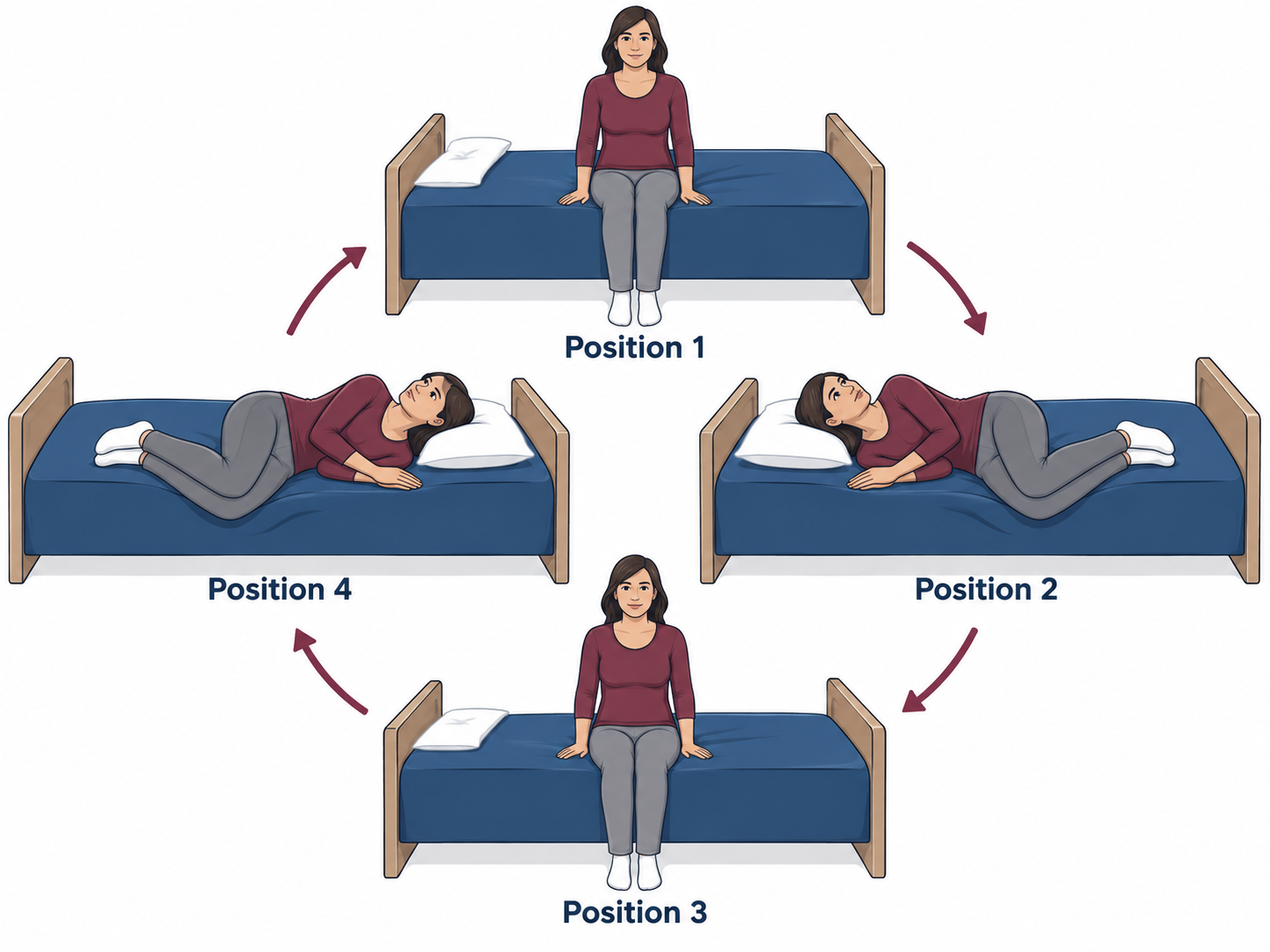
If symptoms persist or recur, your clinician may recommend Brandt-Daroff exercises at home.
These exercises repeatedly move the head and body through specific positions to help reduce positional vertigo over time.
They are usually performed several times a day for a short period, depending on your clinician’s instructions.
Stop and seek reassessment if symptoms are very different from your usual positional vertigo, become continuous, or are associated with neurological symptoms.
After treatment
You may feel mildly dizzy or off balance for a short time after the maneuver.
Strict sleeping-position restrictions are usually not necessary after treatment.
BPPV can return in the future. If the same positional spinning symptoms recur, reassessment and another repositioning maneuver may be needed.
When is dizziness not typical of BPPV?
Seek medical assessment if dizziness is:
- Continuous rather than brief and position-triggered
- Associated with new hearing loss
- Associated with severe headache
- Associated with weakness, numbness, difficulty speaking, double vision, or difficulty walking
- Associated with loss of consciousness
Important: Not all dizziness or vertigo is caused by BPPV. This page provides general information and is not a diagnosis. New, persistent, or unusual symptoms should be medically assessed.