
Page Summary
- A CSF leak occurs when fluid surrounding the brain passes through an opening in the skull base into the nose or sinuses.
- It can cause clear, watery nasal drainage, often from one side.
- Diagnosis may involve nasal examination and imaging to identify the leak and the skull base defect.
- Many skull base CSF leaks can be repaired endoscopically through the nose.
Clear watery drainage from the nose is commonly caused by rhinitis, not a CSF leak. Certain features, described below, are the ones worth having assessed.
Cerebrospinal Fluid
Cerebrospinal fluid, often shortened to CSF, is the clear fluid that surrounds and cushions the brain and spinal cord.
What Is a CSF Leak?
A CSF leak (also called CSF rhinorrhea) happens when there is an opening in the skull base that allows this fluid to leak into the nose. It can happen after an injury or surgery, or spontaneously.
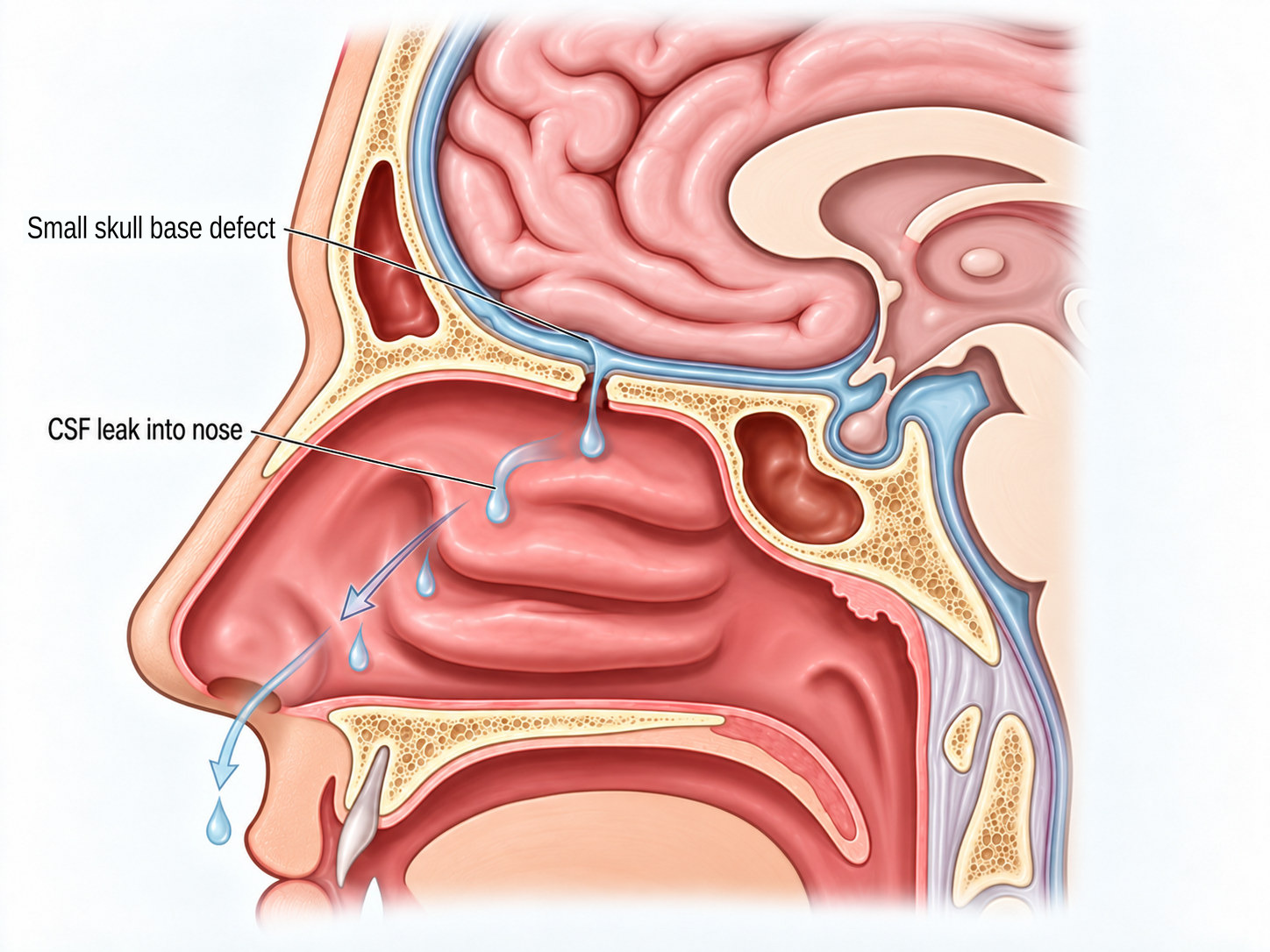

Original educational illustration created by the author; anatomy is simplified for clarity. Source: Samargandy S, 2026.
How to cite this figure →What Is a Skull Base Defect?
The skull base is the bone that separates the brain from the nose and sinuses. In some areas it is very thin.
A skull base defect is a small opening in this bone. It may result from injury, previous surgery, increased pressure inside the head, or may develop without a clear cause. Through this opening, cerebrospinal fluid can leak into the nose.
Common symptoms
- Clear, watery fluid dripping from one side of the nose, often worse when leaning forward.
- A salty taste in the back of your throat.
Why does it happen?
Causes include head injury, past sinus or skull base surgery, and high pressure around the brain. Some leaks happen without any clear cause, most often in people with raised pressure inside the head.
How Is a CSF Leak Diagnosed?
Diagnosis usually involves two steps.
1. Confirming the fluid is cerebrospinal fluid
A sample of the clear nasal fluid may be tested for a protein found specifically in cerebrospinal fluid, such as beta-2 transferrin. This helps confirm whether the fluid is truly CSF rather than ordinary nasal secretions.
2. Finding the location of the leak
Once a leak is confirmed or strongly suspected, imaging is used to locate the skull base defect. This usually includes a CT scan of the sinuses and skull base, and an MRI scan when needed. Nasal endoscopy may also be used to examine the nose. In some cases, additional specialised imaging may be required if the exact site is difficult to identify.
Treatment
Most CSF leaks require surgical repair to close the opening in the skull base and reduce the risk of infection.
Repair is usually performed through the nose using endoscopic skull base surgery, without an external incision. The surgeon identifies the defect and seals it using tissue or graft material chosen for the size and location of the opening. See Endoscopic CSF Leak Repair for what the operation involves.
In selected cases, a leak following recent trauma may be observed for a short period to see whether it closes on its own.
After repair, follow-up is important to confirm that the leak has resolved. If raised pressure inside the head contributed to the leak, this may also need to be treated to reduce the risk of recurrence.
When should I seek urgent care? New clear fluid from your nose after a head injury or skull base surgery — especially with fever or headache — should be checked promptly.
Why Is This Important?
A CSF leak creates a connection between the nose and the space around the brain. This increases the risk of meningitis, an infection of the lining of the brain. Because of this, confirmed CSF leaks should be evaluated and treated rather than left untreated.
Vaccination
If you have a confirmed CSF leak, make sure your pneumococcal vaccine is up to date. This helps lower the risk of meningitis. Your doctor can check which vaccine is appropriate for you.
Frequently asked questions
Is every clear runny nose a CSF leak?
No. Most clear, watery drainage from the nose is caused by common conditions such as allergic or non-allergic rhinitis or a cold. See a doctor if the fluid comes from one side only, tastes salty at the back of your throat, gets worse when you lean forward, or if you have had a head injury or previous sinus surgery. A simple lab test can check the fluid, and a scan can help find where it is coming from.
What if the leak is small and I have no other symptoms?
Even a small CSF leak creates a pathway between the nose and the space around the brain, which carries a risk of meningitis. For this reason, a confirmed leak is usually treated even if it is minor and you feel well.
Will I need brain surgery?
No. Most CSF leaks from the nose are repaired endoscopically through the nostrils, without any cuts on the face or opening of the skull from outside.
Can CSF leaks come back after repair?
It's uncommon, but leaks can recur, especially if the underlying cause, such as high pressure around the brain, isn't also addressed. This is why follow-up after repair matters.
Do I need antibiotics until surgery?
No. Antibiotics are not routinely needed while waiting for surgery. They don't prevent meningitis and are not recommended just because a CSF leak is present. If you develop fever, severe headache, or neck stiffness, seek care immediately.