
The skull base is the part of the skull that supports and separates the brain from structures below it, including parts of the nose and sinuses.
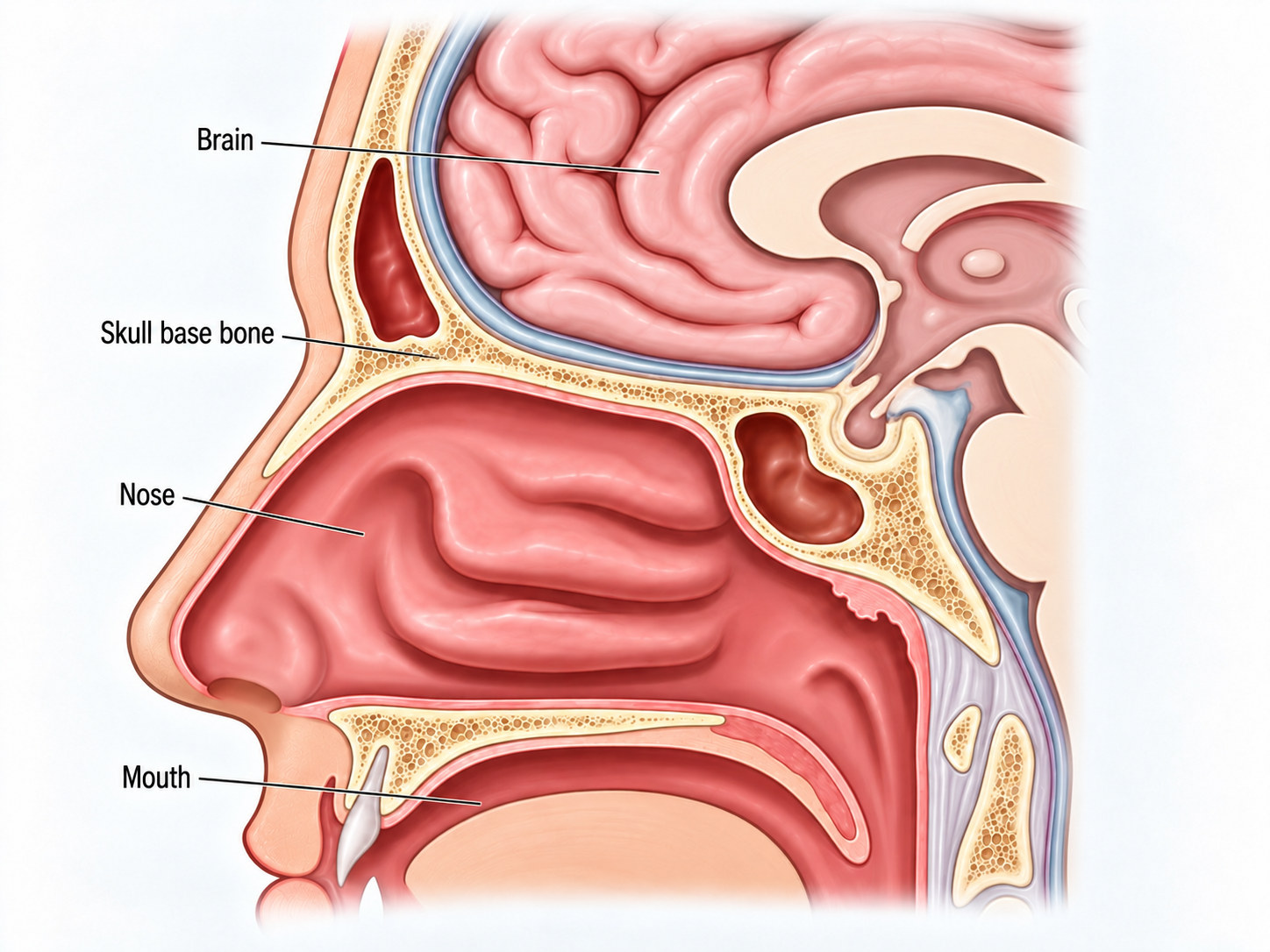
Original educational illustration created by the author; anatomy is simplified for clarity. Source: Samargandy S, 2026.
Where is the skull base?
The skull base forms the floor of the space that contains the brain.
At the front and center of the skull, parts of the skull base also form the roof of the nasal cavity and several sinuses. In some areas, only thin layers of bone and tissue separate the nose and sinuses from the brain and its coverings.
The skull base is not one single flat bone. It is a complex three-dimensional area with openings for important nerves and blood vessels.
Why is the skull base relevant to rhinology?
Because parts of the skull base sit directly next to the nose and sinuses, some conditions in this area can be reached through the nostrils using an endoscope.
These include selected:
- cerebrospinal fluid (CSF) leaks;
- skull base tumors;
- sinonasal tumors involving the skull base;
- other lesions along the anterior or central skull base.
What is endoscopic skull base surgery?
Endoscopic skull base surgery uses an endoscope and specialized instruments passed through the nose to reach selected areas of the skull base.
For some conditions, this allows the surgeon to reach the area without an external facial incision. The exact approach depends on the location and extent of the disease. Not every skull base condition can or should be treated through the nose.
Because the brain, eyes, major blood vessels, and important nerves may be close to the surgical area, detailed imaging and careful surgical planning are essential.