
The eustachian tube is a narrow channel that connects the middle ear to the back of the nose (the nasopharynx). It opens briefly when you swallow or yawn, letting air into the middle ear so that the pressure on both sides of the eardrum stays balanced.
Eustachian tube dysfunction (ETD) happens when the tube does not open or close properly.
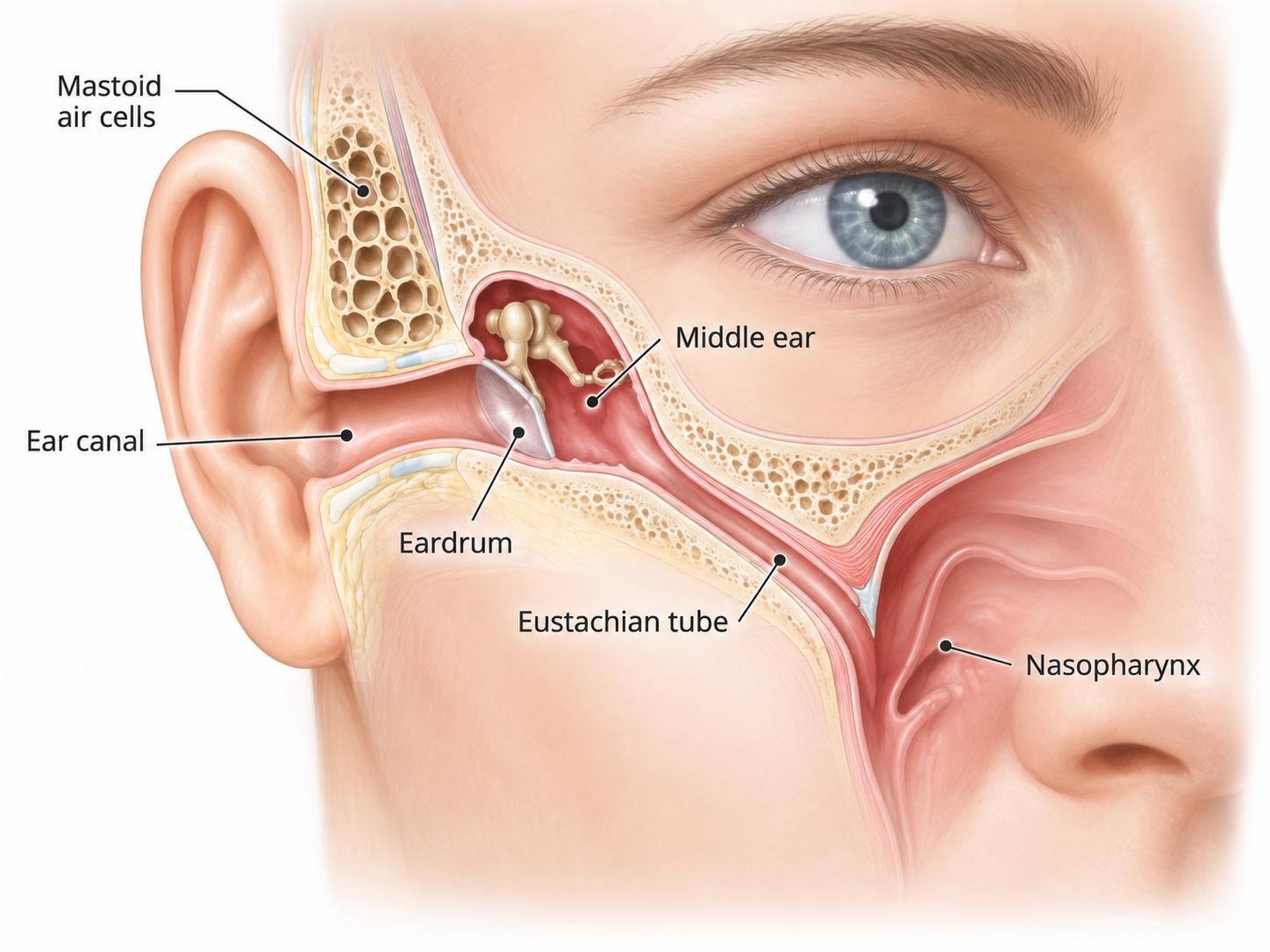
Types of eustachian tube dysfunction
- Obstructive: the tube does not open well enough. This is the most common type.
- Pressure-related (baro-challenge): symptoms happen mainly with pressure changes, such as flying or diving.
- Patulous: the tube stays open too much. This can make your own voice or breathing sound loud in the ear. It is managed differently.
Typical symptoms
- A blocked, full, or pressure feeling in the ear
- Muffled hearing
- Popping or crackling sounds
- Ear discomfort, especially when flying
- Difficulty “popping” the ears
Common causes
- Colds and other upper respiratory infections
- Allergic rhinitis and other nasal inflammation
- Chronic rhinosinusitis
- Enlarged adenoids, mainly in children
- Exposure to tobacco smoke
Eustachian tube symptoms after a cold often settle on their own within a few weeks.
How is it diagnosed?
Diagnosis is based on your symptoms and an ear examination. A hearing test and tympanometry, which measures how the eardrum moves and the pressure in the middle ear, may be done. The nose may also be examined with a small camera (nasal endoscopy) to look at the back of the nose, where the eustachian tube opens.
Treatment
Treatment depends on the type and the cause. When nasal inflammation is contributing, treating the nose often helps. This may include saline rinses, a steroid nasal spray, or allergy treatment.
Decongestant nasal sprays should only be used for a few days at a time, as longer use can cause rebound congestion.
Autoinflation
Autoinflation means gently pushing air into the middle ear through the eustachian tube. It can help open the tube and relieve pressure.
It can be done by:
- Closing your mouth, pinching your nose, and blowing gently as if blowing your nose
- Swallowing while pinching your nose
- Using an autoinflation device, in which a small balloon is inflated through one nostril
Do not blow forcefully. Stop if it causes ear pain, dizziness, or worsening symptoms.
Eustachian tube dilation
For some people with persistent obstructive eustachian tube dysfunction that does not improve with appropriate medical treatment, balloon dilation of the eustachian tube may be considered.
A small balloon is passed through the nose into the opening of the eustachian tube and briefly inflated to help improve its function.
It is not appropriate for every type of eustachian tube problem, so the diagnosis should be confirmed before considering the procedure.
When should ear symptoms be assessed?
Arrange an ENT assessment if:
- Symptoms last longer than a few weeks or keep coming back
- Symptoms persist in one ear only
- You notice hearing loss
- There is ear pain, discharge, or fever
Seek urgent medical assessment for:
- Sudden hearing loss
- Vertigo, facial weakness, or other neurological symptoms
Important: A blocked or full feeling in the ear is not always caused by eustachian tube dysfunction. It can also occur with earwax, fluid in the middle ear, or inner-ear problems, including sudden hearing loss, which needs urgent assessment. This page provides general information and is not a diagnosis.