
Page Summary
- A deviated nasal septum can narrow one or both sides of the nose and make nasal breathing difficult.
- The inferior turbinates are normal structures inside the nose that can become enlarged and contribute to nasal blockage.
- Nasal sprays can treat rhinitis and reduce swelling of the turbinates, but they cannot straighten a deviated septum.
- When obstruction remains significant, treatment may address the septum, the turbinates, or both.
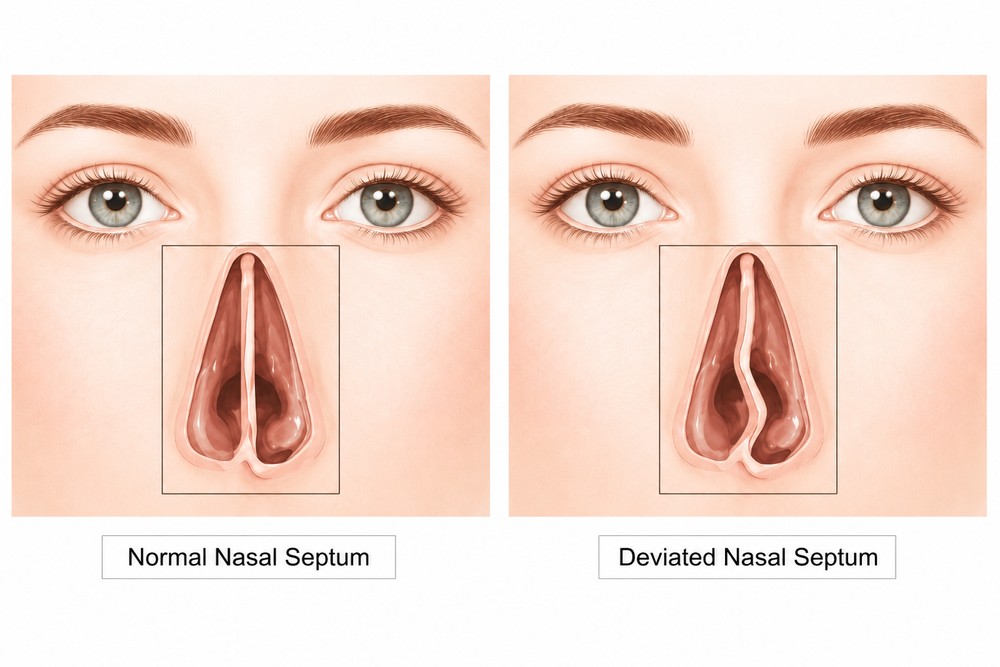

Original educational illustration created by the author; anatomy is simplified for clarity. Source: Samargandy S, 2026.
How to cite this figure →Deviated Nasal Septum & Inferior Turbinate Hypertrophy
The nasal septum is the wall that separates the two sides of the nose. If it is bent or shifted, it can narrow one or both nasal passages and make it harder to breathe through the nose.
The inferior turbinates are normal structures along the side walls of the nose. They help warm, humidify and filter the air we breathe. Their size naturally changes during the day, but they can become persistently enlarged with rhinitis or other nasal inflammation and further narrow the nasal airway.
A deviated septum and enlarged turbinates commonly occur together. Sometimes the septum is the main cause of obstruction; sometimes turbinate swelling contributes significantly; and often both play a role.
Common symptoms
- Difficulty breathing through one or both sides of the nose.
- Nasal blockage that may alternate between sides or become more noticeable when lying down.
- Persistent congestion, particularly when rhinitis or turbinate swelling is also present.
- Mouth breathing or dry mouth.
- Reduced nasal airflow during exercise or sleep.
Diagnosis
Examination of the nose helps determine how much of the blockage is related to the septum, the inferior turbinates, or other causes of nasal obstruction. A nasal endoscopy may be used when a more detailed examination is needed.
Treatment
Treatment depends on what is contributing to the obstruction.
When rhinitis and enlarged turbinates are contributing, treatment may include saline irrigation, nasal steroid sprays and treatment of any underlying allergy. These treatments can reduce inflammation and turbinate swelling, but they do not change the shape of a deviated septum.
If significant obstruction continues despite appropriate medical treatment, surgery may be considered. Septoplasty corrects the part of the septum that is narrowing the airway. Turbinoplasty reduces the size of enlarged inferior turbinates while preserving their normal function as much as possible. Some patients need one procedure; others benefit from both.
Frequently asked questions
Is a deviated septum common?
Yes. Many people have some degree of septal deviation. Treatment is only needed when it is causing nasal obstruction or blockage.
Can enlarged turbinates come back after treatment?
After office-based coblation, the turbinates may enlarge again over time, particularly if allergy or inflammation persists. After turbinoplasty, the reduction is generally more lasting, although nasal congestion can still recur if underlying allergy or inflammation remains active. Ongoing nasal treatment may still be needed if allergy or inflammation continues.
Do I always need both septoplasty and turbinate surgery?
It depends. The choice depends on which structures are contributing to the nasal obstruction. Some patients need only septoplasty or turbinate surgery, while others may benefit from both procedures.