
Page Summary
- The frontal sinus drainage pathway is narrow and anatomically complex.
- Surgery ranges from a targeted opening to more extended procedures depending on the disease and anatomy.
- The extent of surgery is tailored to the individual problem rather than using the same operation for everyone.
- Follow-up is particularly important because the opening can narrow during healing.
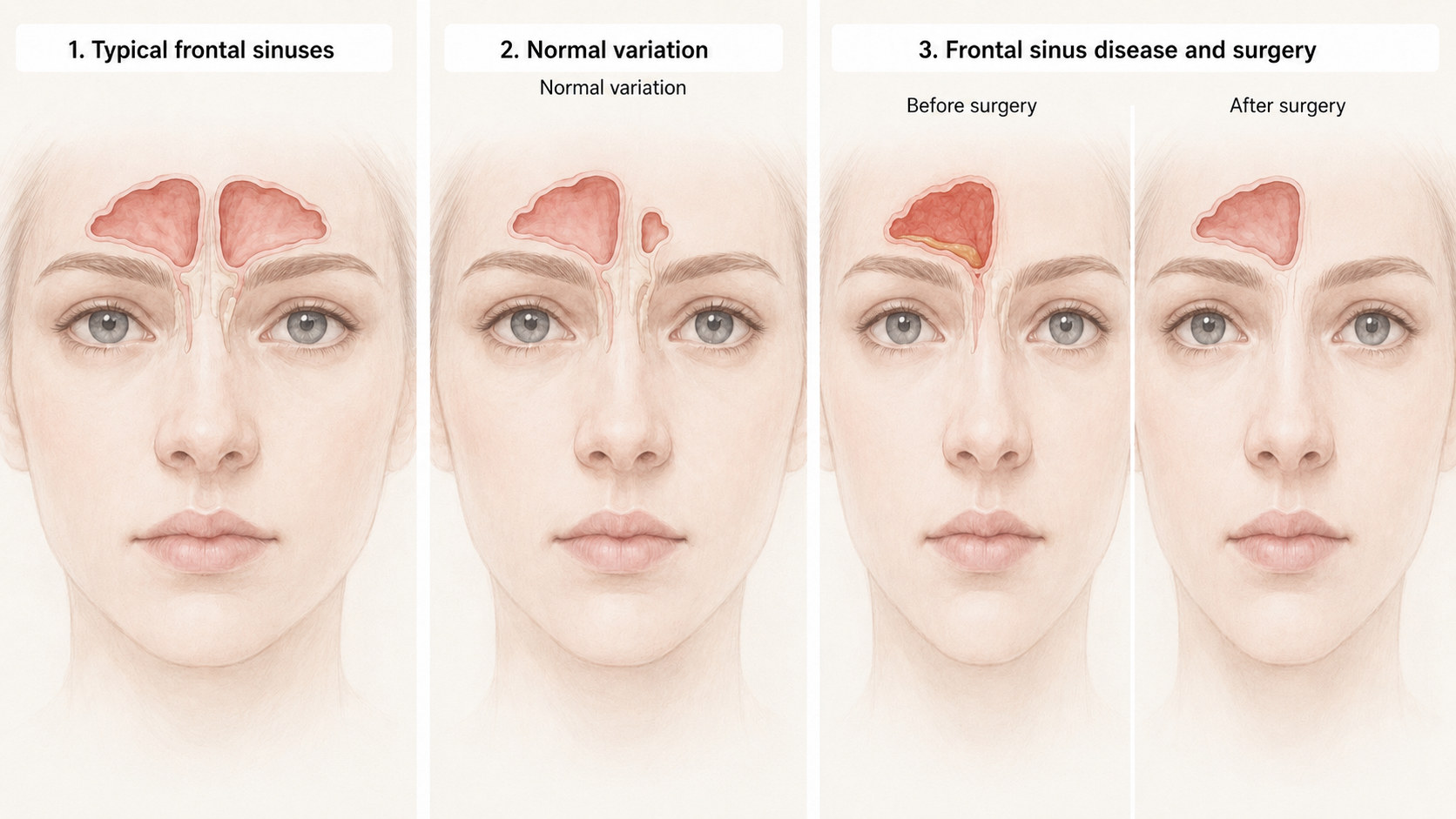

Original educational illustration created by the author; anatomy is simplified for clarity. Source: Samargandy S, 2026.
How to cite this figure →Why is the frontal sinus different?
The frontal sinuses sit above the eyes, and their size and shape vary from person to person. One may be very small or absent, which is a normal variation and does not need treatment.
The frontal sinus drains into the nose through a narrow pathway that can vary a great deal between people, which makes it more complex to reach and treat than some of the other sinuses.
Who may benefit?
Whether frontal sinus surgery is needed is decided by the type of problem, the shape of the sinus and its drainage pathway, what treatment has already been tried, and what the examination and scans show.
It may be considered when there is persistent or recurrent disease, narrowing or scarring of the drainage pathway, nasal polyps extending into the frontal sinus, or in selected complex or revision cases.
None of these means surgery is automatically needed.
What happens during surgery?
The surgery is performed endoscopically through the nose. The goal is to open the frontal sinus and improve its drainage and the delivery of rinses and topical treatment to it. Inflamed tissue or scar tissue may be removed when needed.
How much surgery is needed depends on the type of problem, the shape of the sinus, and the drainage pathway. A limited opening is enough in some cases, while others need a wider opening.
Healthy sinus lining is preserved wherever possible, to support healing and reduce scarring.
After surgery
Nasal rinses are important after surgery, to clear crusts and secretions and to help topical treatment reach the frontal sinus.
Follow-up
Regular follow-up is important after frontal sinus surgery, because the opening can narrow or scar as it heals. The visits allow healing to be checked and any narrowing or scarring to be treated early when needed.
Smoking and surgery
Stopping smoking is strongly recommended for at least 4 weeks before surgery and 4 weeks afterward. Smoking increases the risk of breathing and anesthesia-related complications, infection, and delayed healing. If your surgery is sooner, stopping now is still beneficial.