
Page Summary
- Enlarged inferior turbinates can contribute to persistent nasal blockage.
- Coblation uses plasma technology to reduce their volume while preserving the surface lining.
- The procedure is performed through the nose under local anesthesia.
- It treats turbinate enlargement, not every cause of nasal obstruction.
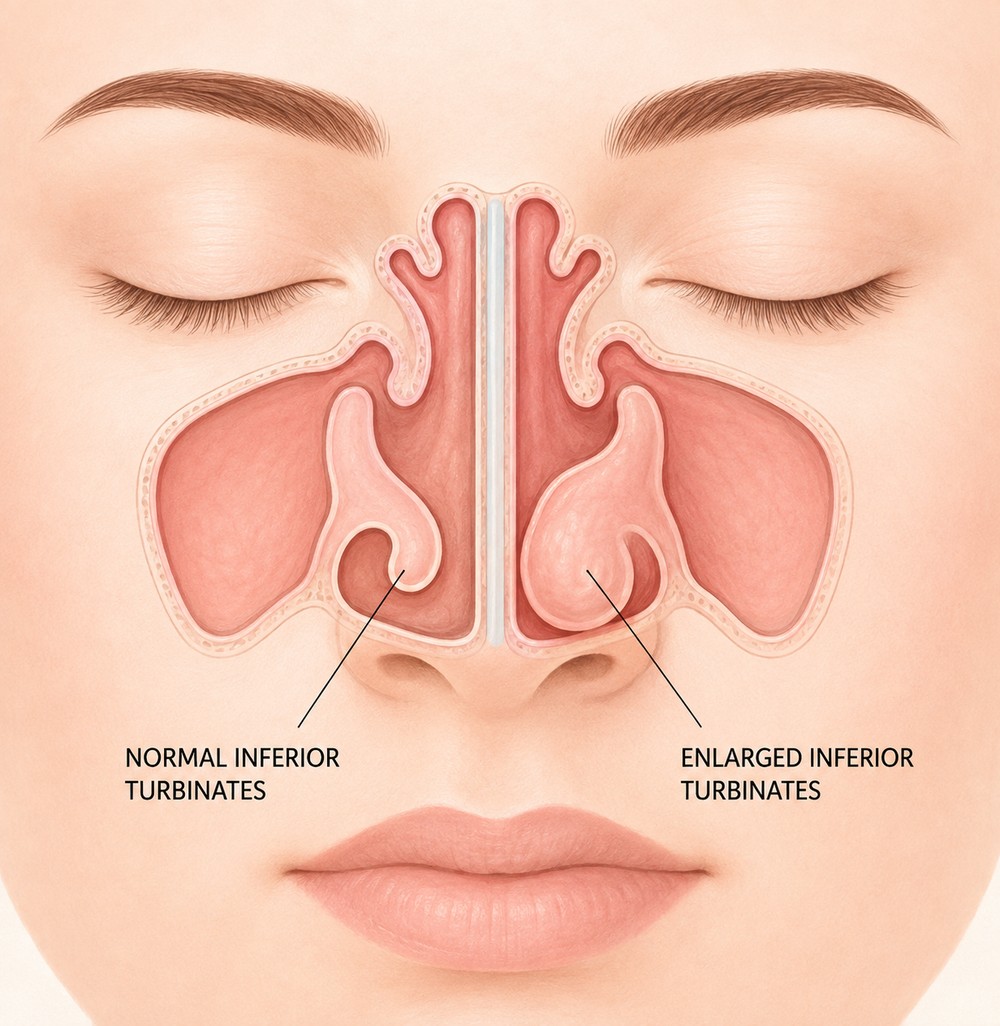

Original educational illustration created by the author; anatomy is simplified for clarity. Source: Samargandy S, 2026.
How to cite this figure →Enlarged Inferior Turbinates
Turbinates are shelf-like ridges inside the nose that help regulate, humidify and filter the air passing through it. When they become enlarged, they can narrow the airway and make it harder to breathe through the nose. This is one of the most common causes of a blocked nose.
Medical treatment comes first
Before considering a procedure, treatment usually starts with saline nasal sprays and steroid nasal sprays, along with allergy treatment when needed. Many patients improve with medical treatment and do not need an additional procedure.
What is Coblation?
Coblation is a simple office-based procedure used to reduce the size of the turbinates and improve nasal breathing without the need for an operating room.
Who may benefit?
It may be suitable for people with mild to moderate turbinate enlargement and persistent nasal blockage despite medical treatment, provided there is no significant deviated septum that needs correction. It is not suitable for patients who need to remain on blood thinners that cannot be stopped temporarily.
How does it work?
A thin probe is placed inside the turbinate to reduce the tissue from within, while preserving as much as possible of the lining and surface mucosa.
What happens during the procedure?
The procedure is performed under local anesthesia. The inside of the nose is numbed with a spray, and a small injection may be used if needed. You remain awake and may feel some pressure or warmth. The procedure takes about 10–15 minutes on each side.
What to expect afterward
Some stuffiness and swelling in the first few days is normal — it's part of healing, not a sign of a problem. Most people go back to their normal day the same day or the next. Breathing usually improves gradually over two to four weeks, as the swelling goes down.
Risks
The procedure is generally safe and well tolerated, with a very low risk of bleeding. In some patients, the benefit may decrease over time and the procedure may need to be repeated.
When is full turbinate surgery better? If your turbinates are significantly enlarged, if coblation didn't give lasting relief, or if you're already having surgery for another reason like septoplasty, a more thorough procedure in the operating room may be the better choice.